Back to Legal InsightsForeign Investment
Registering a Company in Beijing as a Foreign Investor: A Step-by-Step Legal Guide
2026-08-2012 min read
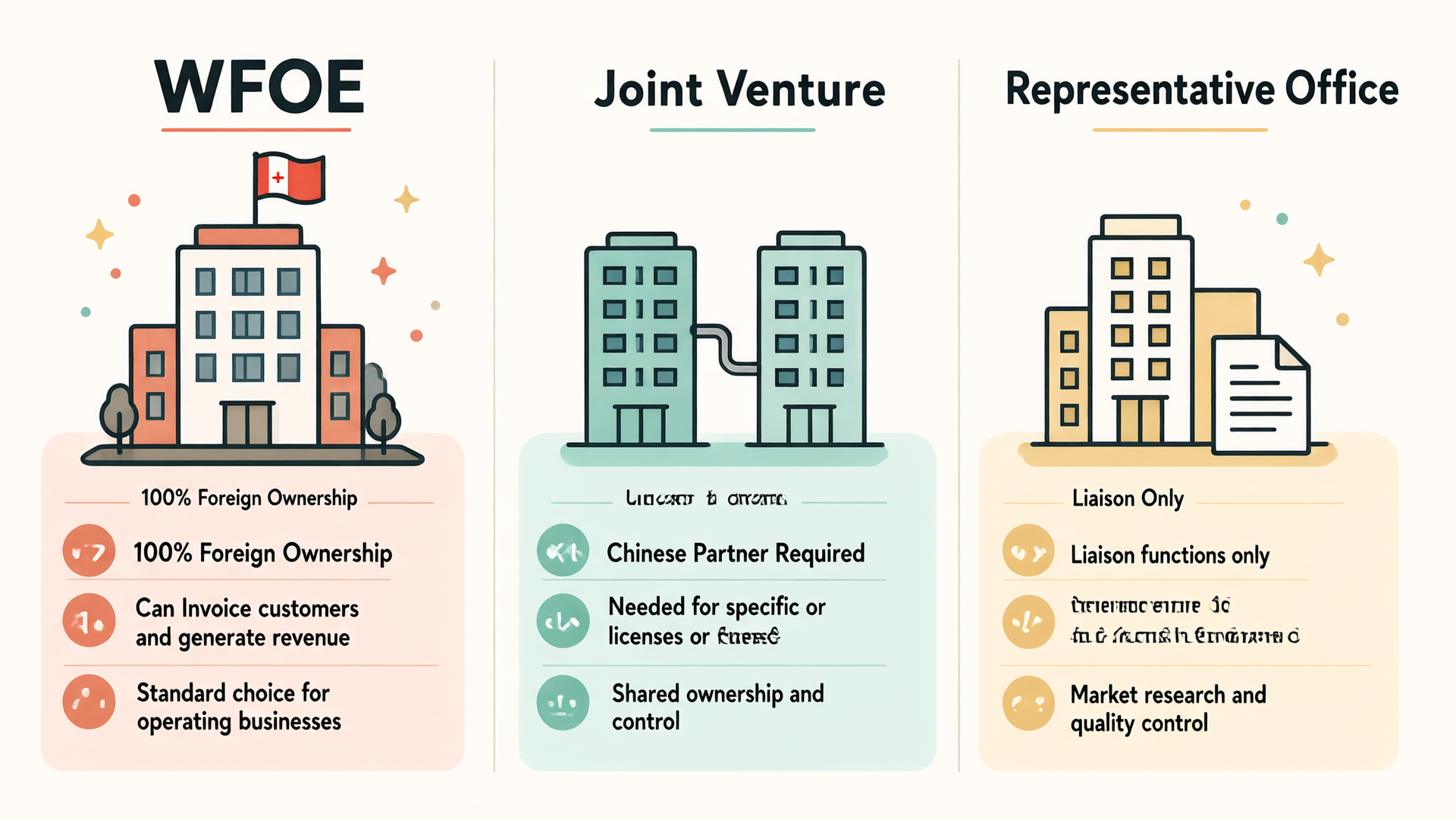
Since the Foreign Investment Law took effect on January 1, 2020, China has replaced the case-by-case approval system with a national treatment plus negative list framework. For most industries, foreign investors now register directly with the market regulator through a record-filing and information reporting system, rather than seeking prior government approval.
Foreign investors entering China typically choose among three structures, each with distinct operational implications. A wholly foreign-owned enterprise (WFOE), organized as a limited liability company, is the standard vehicle for operating a revenue-generating business. It allows the foreign shareholder to hold 100 percent equity, invoice customers, hire employees, and repatriate profits after tax. A joint venture becomes necessary when the business requires a Chinese partner's license, market access, or regulatory approval that a WFOE cannot obtain independently. A representative office serves only liaison functions, such as market research or quality control, and cannot issue invoices or generate revenue. For most commercial operations, the WFOE remains the appropriate choice.
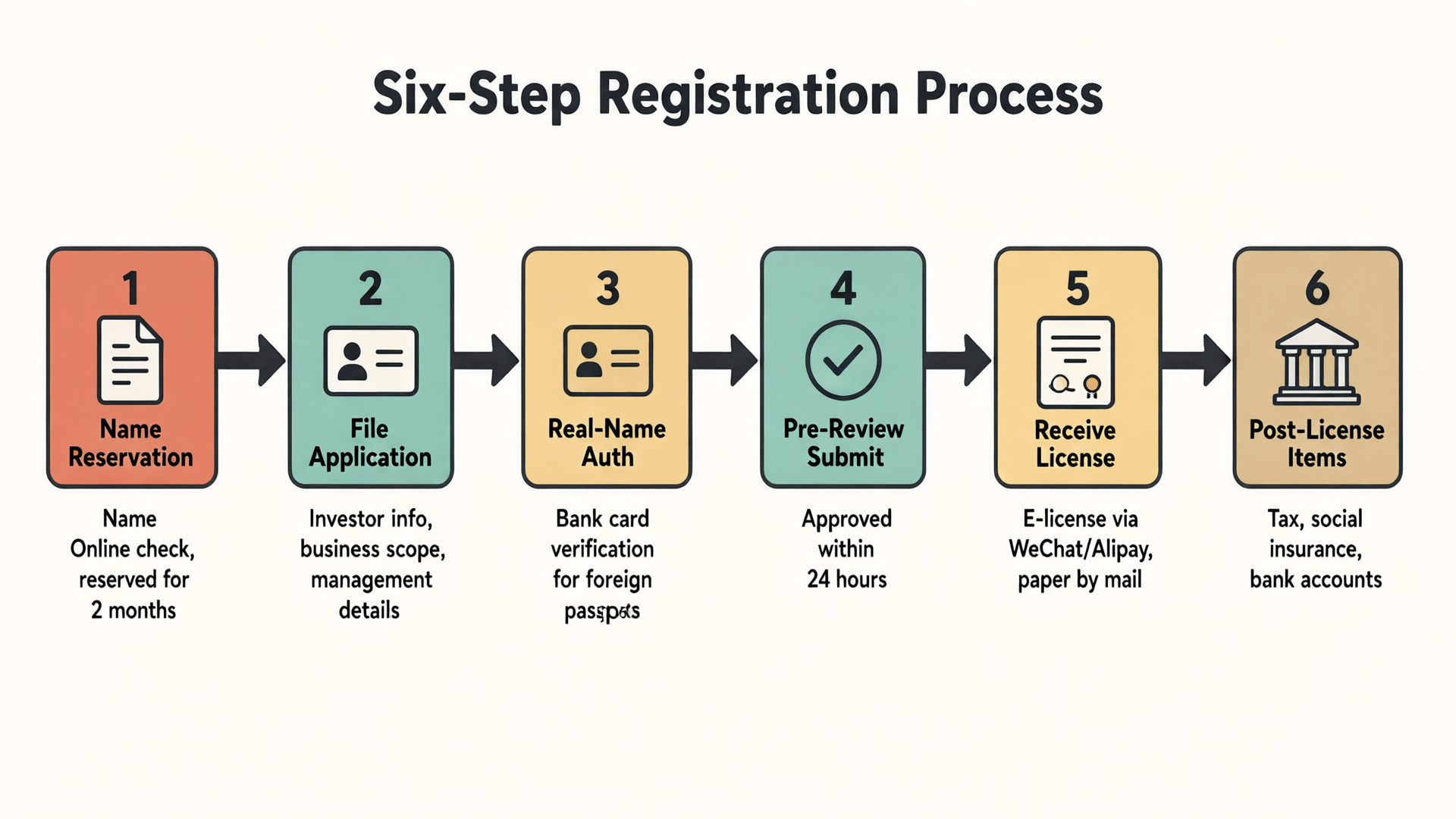
All registration steps in Beijing are completed online through the E-Window Platform. The first step is name reservation, which is checked against the existing registry and held for two months. The second step involves filing the establishment application, including investor information, a standardized business scope selected from the official catalog, and details of senior management personnel such as the legal representative, directors, supervisor, manager, and finance officer. The system auto-generates the articles of association based on these inputs.
The third step is real-name authentication. Foreign passport holders complete verification through a Chinese bank card linked to a Chinese mobile number. Holders of a PRC Permanent Residence Card may use facial recognition or bank card verification. No separate digital signature setup is required. The fourth step is submitting the application for pre-review, which is typically approved within 24 hours. At this stage, applicants may optionally bundle free seal carving, tax registration, social insurance pre-registration, and a bank account appointment.
The fifth step is receiving the business license. An electronic license is issued instantly through the WeChat or Alipay Electronic Business License mini-program, while the paper license can be collected at the district service center or mailed. The sixth step covers post-license items: tax registration, social insurance enrollment covering the five statutory insurances and housing fund, and opening a basic bank account along with a foreign currency capital account.
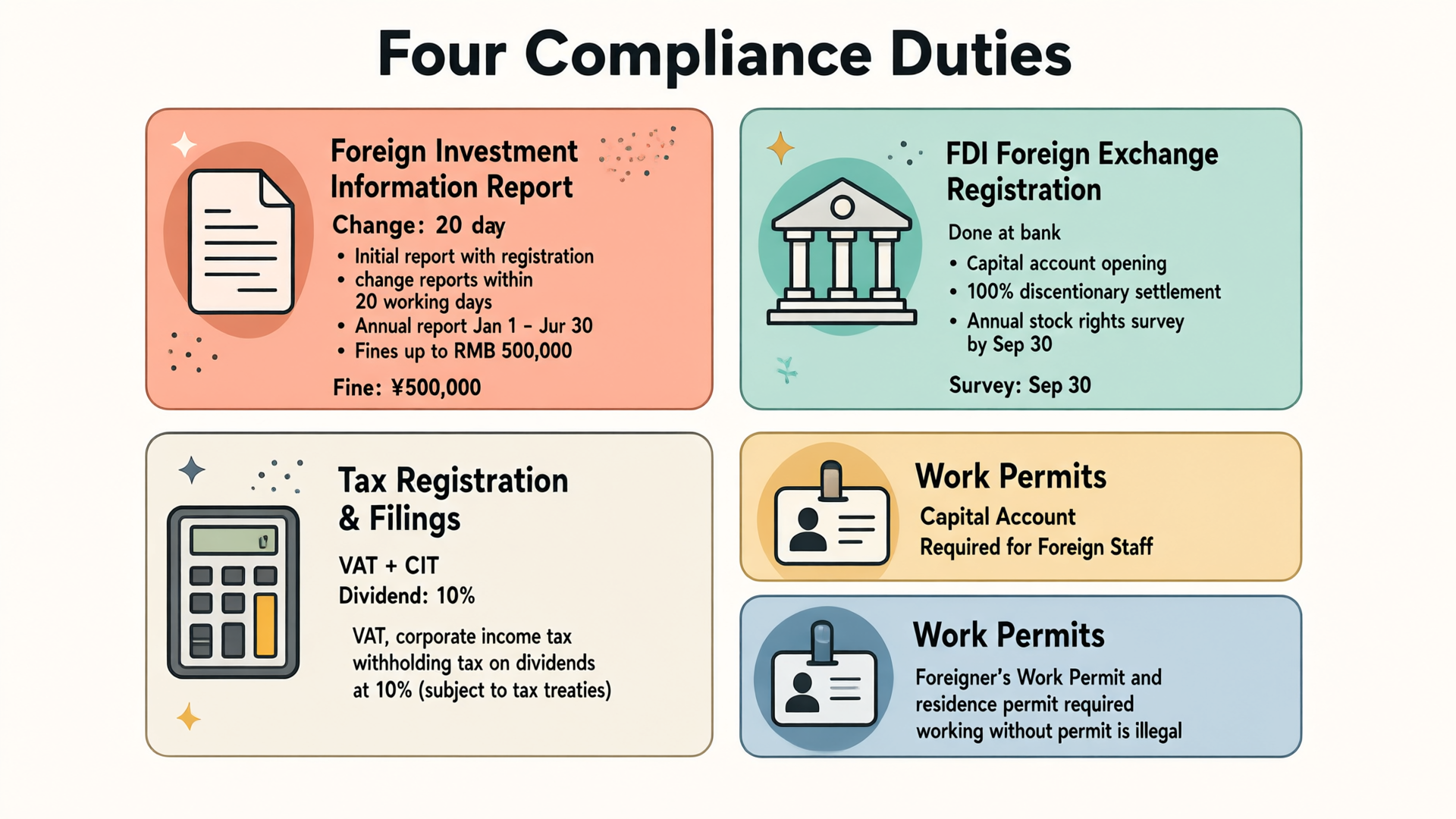
Foreign investors often focus on obtaining the business license and overlook the ongoing compliance obligations. The first duty is the Foreign Investment Information Report, required under MOFCOM and SAMR Order No. 2 of 2019. The initial report is filed together with the registration application, change reports must be submitted within 20 working days of any modification, and the annual report is due between January 1 and June 30 through the National Enterprise Credit Information Publicity System. Failure to file can result in fines up to RMB 500,000.
The second duty is foreign direct investment foreign exchange registration under SAFE Circular 2015 No. 13. This is completed directly at the bank, where the business registration certificate is obtained, the capital account is opened, and capital contributions are recorded. Under current policy, capital can be settled at will with 100 percent discretionary settlement. An annual stock rights survey must also be filed by September 30.
The third duty involves tax registration and ongoing filings, including value-added tax, corporate income tax, and withholding tax on dividends distributed to non-resident shareholders at a standard rate of 10 percent, subject to reduction under applicable tax treaties. The fourth duty applies when foreign nationals will work in China: the employing entity must apply for a Foreigner's Work Permit and residence permit through the Ministry of Science and Technology service platform. Working without a valid permit violates Article 80 of the Exit-Entry Administration Law.
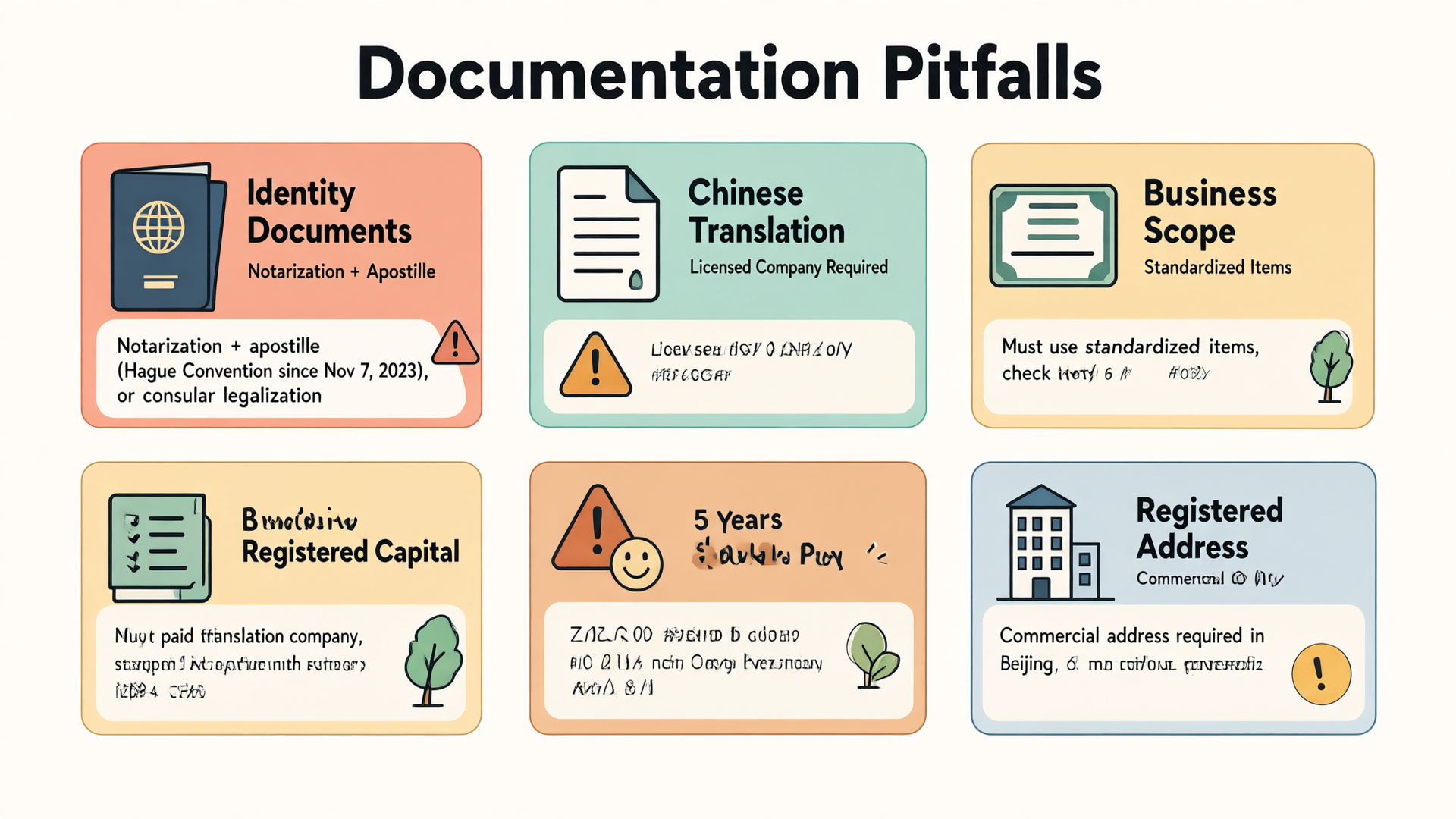
The most common obstacles foreign investors encounter relate to documentation rather than procedure. Identity documents must be notarized and legalized through consular authentication, or apostilled under the Hague Convention, which China has accepted since November 7, 2023. Passports bearing a valid Chinese visa and entry record may be used without notarization after the originals are verified in person. All foreign-language documents must be translated by a licensed translation company and stamped with certification.
The business scope must use standardized items from the official catalog, and investors should verify that their intended activities do not fall within the Negative List for Foreign Investment Access. Under the revised Company Law effective in 2024, registered capital must be fully paid within five years of establishment. Real-name verification requires a Chinese bank card for passport holders, which should be arranged before starting the registration process.
In Beijing, residential premises generally cannot serve as the registered address. Investors must use a compliant commercial address or a licensed virtual-office registration service. The electronic business license pickup typically requires the legal representative of a foreign-owned company to appear in person or sign a power of attorney. Finally, ongoing compliance obligations, including the annual report, foreign exchange stock rights survey, tax filings, and social insurance contributions, must be maintained. Missed filings lead to business restrictions and potential penalties.
Registering a company in Beijing as a foreign investor is a structured process with clear legal requirements, but the documentation standards and compliance obligations demand careful attention. From identity document authentication to post-registration reporting, each step carries specific deadlines and formatting rules that, if overlooked, can delay operations or trigger penalties.
Our firm regularly assists foreign investors in navigating these requirements, ensuring that registration proceeds efficiently and that ongoing compliance obligations are met from the outset.
For legal assistance with company registration, compliance matters, or any foreign-related legal services in China, contact Global Bridge Legal:
Phone: +86 158 1078 8943 | Email: lawyermichaelcn@outlook.com
Our team of PRC-licensed attorneys is available Monday through Sunday, 9:00 AM to 6:00 PM, to schedule a confidential consultation.
Need Legal Assistance?
If you have questions about this topic or need personalized legal counsel, our team is here to help.
Schedule a ConsultationA comprehensive overview of legal structures, registration processes, and regulatory considerations for foreign investment in China.
Intellectual PropertyPractical steps for trademark registration, patent filing, and enforcement actions to safeguard intellectual property in the Chinese market.